By the time we reached the village, most of the day had disappeared.
The road had taken longer than expected, winding through dry hills and olive trees. We had stopped a few times along the way — once for the view, once because a goat was standing in the middle of the road, and once simply because the afternoon light had turned the hills gold.
So when we arrived, we were hungry.
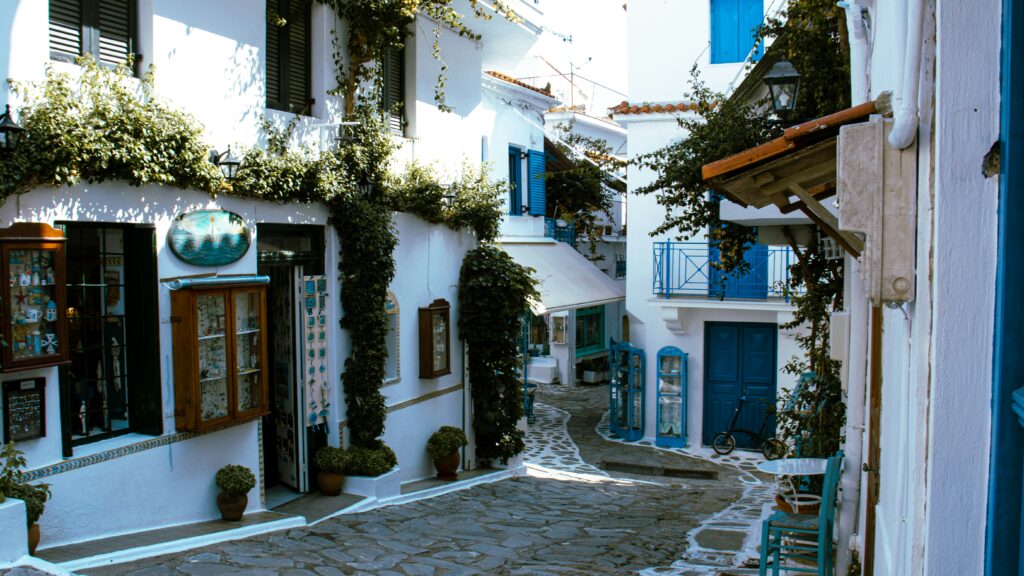
The village was small, with stone houses climbing the hillside and narrow streets disappearing around corners. It was that quiet part of the afternoon when everything seemed to have paused.
There were two tavernas.
One had a faded blue sign. The other had wooden tables under a large vine and not a single customer.
We chose the empty one.
An older man came out, looked at us, and pointed to a table.
“Two?”
We nodded.
Before we had properly opened the menu, he came back.
“Fish?”
We looked at each other.
“Okay.”
Apparently, that was enough.
Bread arrived first, then tomatoes, olives, feta, and something with aubergine that we couldn’t identify but kept eating anyway.
We tried asking what everything was. Sometimes he explained. Sometimes he simply smiled and said, “Good.”
Then a woman came out of the kitchen carrying a pan. She said something to him in Greek. He answered. She shook her head and laughed.
A few minutes later, she brought us another dish.
It was probably the best thing we ate that evening.
A meal can tell you things about a place that a guided tour sometimes cannot.
As we ate, the village slowly came to life. A man on a scooter stopped for a beer. Two older women paused outside to talk. A child appeared with a football and was immediately told not to kick it near the tables.
The restaurant that had looked deserted when we arrived suddenly felt like the center of the village.
We were the only people there who didn’t know anyone.
And somehow, that was fine.
The owner eventually sat down for a few minutes. His English was limited, our Greek was worse, and the conversation depended on gestures, place names, and a lot of smiling.
He asked where we were staying. We showed him on the phone.
He pointed in the opposite direction and laughed.
Then came the usual questions: where we were from, how long we were staying, whether we had visited the nearby villages.
The questions were simple, but he seemed genuinely interested.
Dinner continued.
Grilled fish, potatoes with lemon, beans in tomato sauce, and a salad made with tomatoes that tasted nothing like the ones we were used to at home.
Nobody seemed to be in a hurry.
We had planned to leave after dinner and drive back before it got too late. Instead, we stayed.
Not because anything extraordinary was happening.
Because nothing was.
Sometimes the most memorable travel experiences begin with no particular plan at all.
When we finally asked for the bill, the owner disappeared inside and came back with a small piece of paper.
The amount was less than we expected.
We pointed at the dishes, trying to make sure he hadn’t forgotten something.
He waved his hand.
“No, no.”
Then he brought out watermelon.
We hadn’t ordered it.
So we stayed a little longer.
By then, the village had completely changed. Doors were open, people were sitting outside their houses, and the air had finally cooled.
On the way back to the car, we passed the other taverna.
It was full.
For some reason, that made us smile.
The next morning, we left the village and continued along the coast. There were beaches to see, viewpoints to stop at, and another town waiting at the end of the road.
But that dinner stayed with us.
Not because of the food, or even the village itself.
Because of the table under the vine. The owner’s laugh. The woman in the kitchen. The child with the football. The watermelon we hadn’t ordered.
A completely ordinary evening in a place we had almost driven past.
Sometimes a place stays with you simply because, for a few hours, you felt like you belonged there.